



Customized MT-Jumper for 100G/200G High Speed Transceivers - China Suppliers & Factory Direct Solutions
Product Introduction
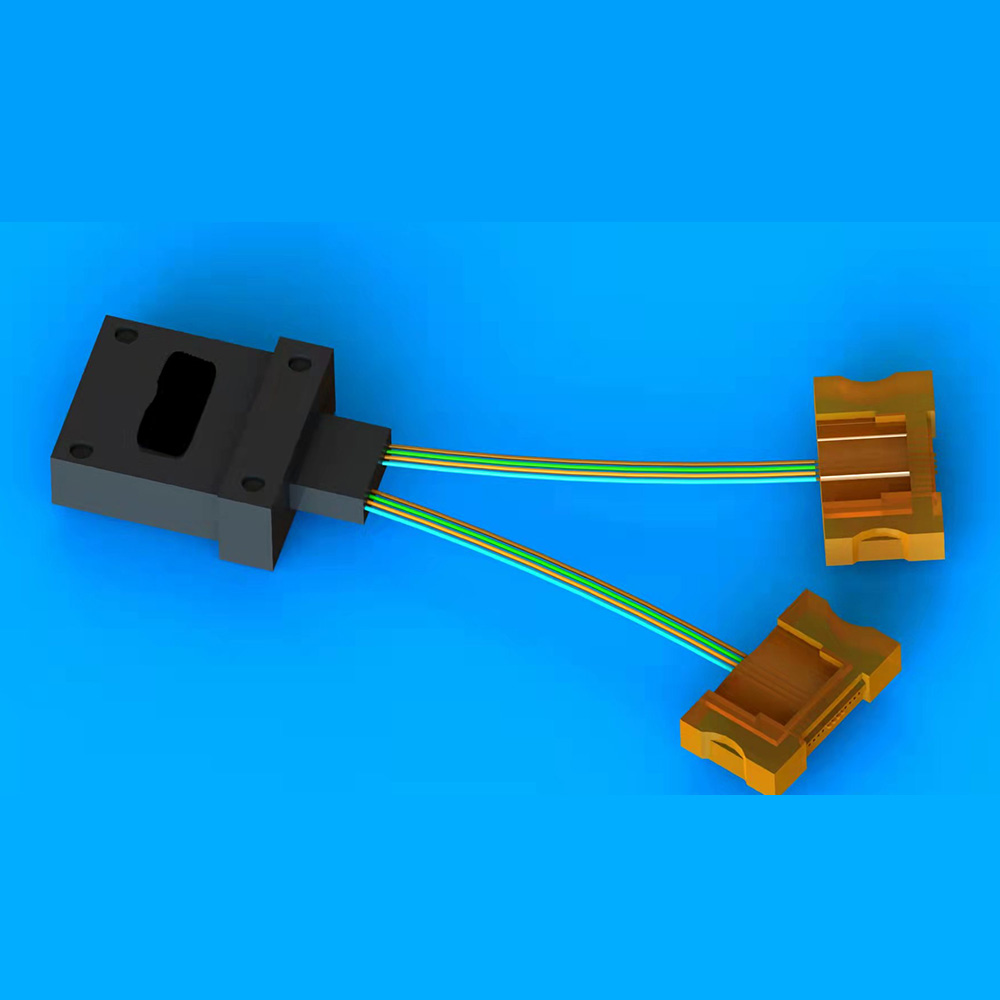
MT-jumper (MT Connector Jumper) is a high-precision, short-reach optical interconnect component specifically designed for internal or external connections in optical modules, enabling low-loss parallel signal transmission.
It is a compact optical jumper with MT (Mechanical Transfer) connectors pre-terminated at both ends—an industry-standard high-density interface. Its primary function is to establish reliable parallel optical links within optical modules (e.g., connecting laser arrays, photodetectors, or AWG chips to module ports) or between modules and external fiber arrays. It supports multi-channel signal transmission in a single connector, optimizing space and ensuring alignment accuracy for high-speed applications.
Key Design & Structural Components
Rectangular ferrule with precision-machined V-grooves. Equipped with two guide pins for self-alignment, ensuring micron-level core positioning. Available in male or female configurations.
Compatible with multimode (OM3/OM4/OM5) and single-mode (OS1/OS2) fibers. Common channel counts include 12, 24, or 48-fiber arrays.
Short-length cable (10–50 mm) with a thin, flexible jacket (PVC or LSZH). Reinforced with aramid yarn to resist tensile stress.
Polished to UPC (Return Loss >45dB/55dB) or APC (Return Loss >60dB) standards for low-reflection applications.
Critical Performance Traits
- Low Insertion Loss: Typical
- Uniformity: Channel-to-channel uniformity
- Mechanical Reliability: Repeatable mating (≥1000 cycles) without alignment drift.
- Temperature Stability: Operates efficiently from -40℃ to +85℃.
- High Density: Compact footprint (e.g., 24-fiber MT ferrule: ~6.4mm × 2.5mm) for QSFP-DD/OSFP modules.
Typical Applications
MT-jumpers are essential in the modern data center ecosystem:
Used in QSFP28, QSFP-DD, OSFP, and 800G/1.6T modules to connect internal photonic components to external ports.
Integrated into PSM4 (Parallel Single Mode) or SR4 (Short-Reach) modules for high-bandwidth data transmission.
They also facilitate signal routing between optical chips (PLC splitters, AWG) and are widely used in module testing setups to validate parallel signal performance.
Frequently Asked Questions
The MT-jumper is designed for high-density, parallel optical interconnects. It connects internal components like laser arrays or AWG chips to the external ports of high-speed optical modules (e.g., 400G/800G).
They commonly support 12, 24, or 48 fibers within a single MT connector, allowing for massive data throughput in a very small physical footprint.
Male connectors feature precision guide pins, while female connectors have guide pin holes. These components work together to ensure micron-level alignment during mating.
Yes, they are compatible with both. Single-mode (OS1/OS2) is typically used for longer reaches with APC polishing, while Multimode (OM3/OM4/OM5) is used for short-reach data center applications.
Typical insertion loss is less than 0.3 dB per channel for multimode and less than 0.5 dB per channel for single-mode, ensuring high signal integrity across all paths.
Yes, MT-jumpers are designed to operate reliably in temperatures ranging from -40℃ to +85℃ and are built to withstand the mechanical stresses of module assembly.