
Leave Your Message
Customized MT-Jumper 100G/200G High Speed Transceiver from China Suppliers and Factory for Multi-Channel Transmission
Hot Products

Customized MT-Jumper 100G/200G High Speed Transceiver from China Suppliers and Factory for Multi-Channel Transmission

,

Introducing our high-performance fiber optic solutions, ideal for data transmission needs in China. Our products support a range of speeds including 40G (4x10G), 100G (4x25G), 100G (2x50G), 200G (8x25G), 200G (4x50G), 400G (8x50G), and 800G (8x100G). As a leading supplier and factory in the optical fiber industry, we ensure multi-channel parallel transmission options, allowing for both fiber direct connections and crosswise connections. Our offerings accommodate various fiber end preparations, such as cutting or polishing, and are compatible with OM1, OM2, OM3, and OM4 standards. Our products also meet stringent GR-326 and GR-468 specifications, ensuring high efficiency for your communication needs. Trust our China-based factory to provide top-quality solutions for your fiber optic projects.

,

    Product Introduction: MT-jumper

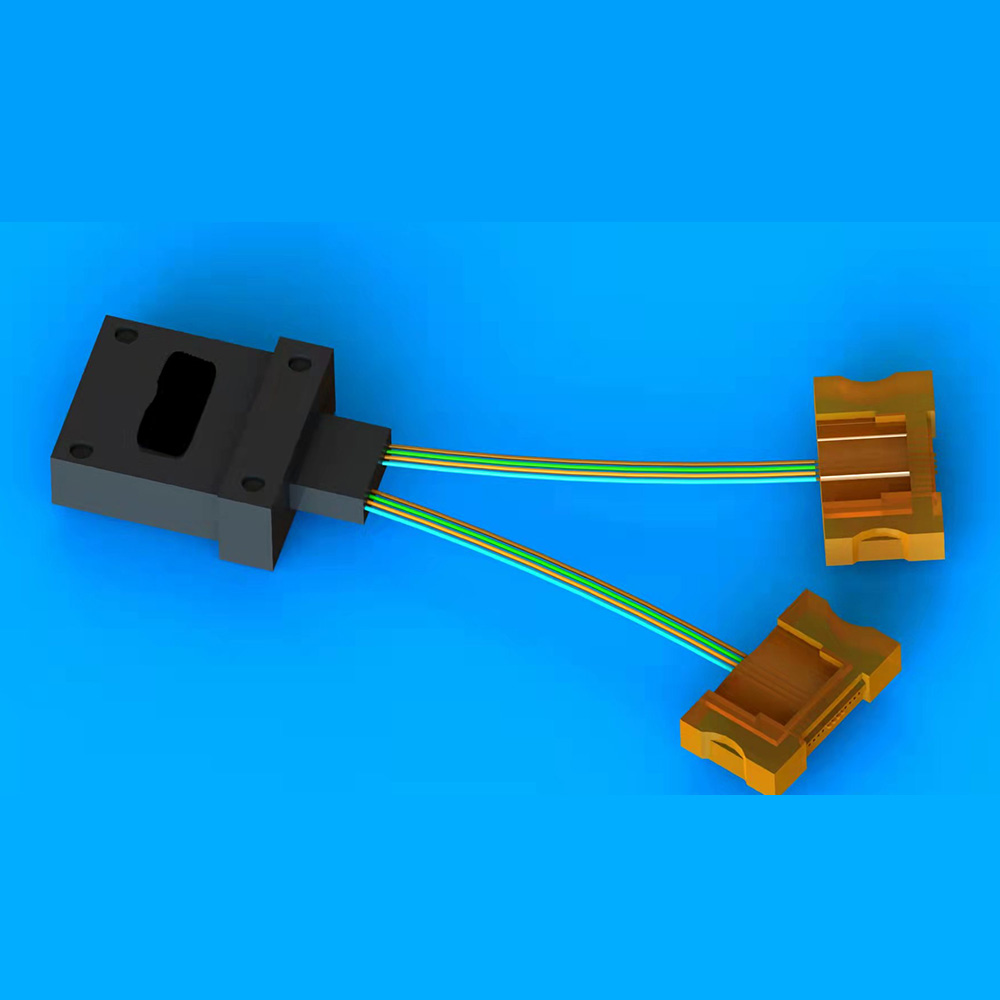
    MT-jumper (MT Connector Jumper) is a high-precision, short-reach optical interconnect component specifically designed for internal or external connections in optical modules, enabling low-loss parallel signal transmission.

    Core Role

    It is a compact optical jumper with MT (Mechanical Transfer) connectors pre-terminated at both ends—an industry-standard high-density interface. Its primary function is to establish reliable parallel optical links within optical modules (e.g., connecting laser arrays, photodetectors, or AWG chips to module ports) or between modules and external fiber arrays. It supports multi-channel signal transmission in a single connector, optimizing space and ensuring alignment accuracy for high-speed applications.

    Key Design & Components

    • MT Connectors: Precision-machined V-grooves with guide pins for micron-level core positioning.
    • Optical Fibers: Compatible with OM3/OM4/OM5 and SM (OS1/OS2) in 12, 24, or 48-fiber counts.
    • Cable Structure: Flexible 10–50 mm short-length cables with LSZH/PVC jackets.
    • Polishing: UPC (Return Loss >45/55 dB) or APC (Return Loss >60 dB) standards.

    Critical Performance

    • Low Insertion Loss:
    • Mechanical Reliability: Repeatable mating ≥1000 cycles without alignment drift.
    • High Density: Compact footprint (6.4mm × 2.5mm) for QSFP-DD and 800G modules.
    • Standard Compliance: Fully compliant with IEC 61754-20 and FA-MT arrays.

    Typical Applications

    High-Speed Transceivers: Used in QSFP28, QSFP-DD, OSFP, and 800G/1.6T modules.
    Parallel Architecture: Integrated into PSM4 and SR4 modules for data centers.
    Internal Interconnects: Signal routing between PLC splitters, AWG chips, and I/O ports.
    Test & Measurement: Custom-length jumpers for validating parallel signal performance.

    Frequently Asked Questions

    What is the primary function of an MT-jumper?
    Its primary function is to establish reliable parallel optical links within high-speed optical modules or between modules and external fiber arrays, supporting multi-channel signal transmission.
    What fiber types are compatible with MT-jumpers?
    They are compatible with both multimode (OM3, OM4, OM5) and single-mode (OS1, OS2) fibers, typically in counts of 12, 24, or 48 fibers.
    What are the typical insertion loss values?
    Typical insertion loss is less than 0.3 dB per channel for multimode and less than 0.5 dB per channel for single-mode, with high uniformity across all paths.
    Which optical modules use MT-jumpers?
    MT-jumpers are essential for high-speed modules like QSFP-DD, OSFP, 400G, 800G, and 1.6T transceivers, as well as PSM4 and SR4 architectures.
    How durable are the MT connectors?
    The precision-engineered guide pins and ferrule allow for repeatable mating of at least 1000 cycles without significant alignment drift or performance loss.
    What are the polishing standards for MT-jumpers?
    They are available in UPC (Ultra Physical Contact) for standard applications and APC (Angled Physical Contact) for single-mode applications requiring low reflection.